
Paving the Way
The year 1658 marks the beginning of the slave trade at the Cape colony. During the first four years of the Dutch East India Company (VOC) settlement at the Cape only a small number of personal slaves had reached the Cape, mostly by accompanying their owners from Batavia until they were sold at the Cape. For four short years the Cape colony had not played any part in the global slave trade.
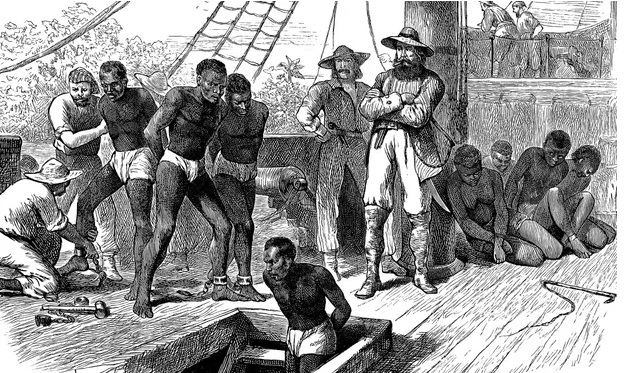
This all changed when, on 28 March 1685, the Dutch merchantman, the Amersfoort, anchored at the Cape with a cargo of 174 slaves. The Amersfoort’s arrival in Table Bay, with slaves in its hold, firmly brought the Cape colony into the fold of one of the most terrible institutions of the last centuries, the Slave Trade.

The Slavery Started

Slavery Abolished
Number of slaves imported between 1652 and 1807

Number of Years of Slavery
Imam ‘Abdullah ibn Kadi Abdus Salaam, known as Tuan Guru, was a prince from Tidore in Indonesia’s Trinate Islands who arrived as a prisoner in Cape Town in 1780. He served twelve years of his sentence and after being released he helped establish the first madrassa in 1793 and the first mosque in 1795.2
He authored one of the early Islamic texts during his incarceration:
A fragment from an early Islamic text used in madrassas in South Africa. It is written in Arabic script, but reads as Cape Dutch.
While imprisoned on Robben Island, Imam ‘Abdullah [Tuan Guru], being a hafiz al-Qur‘an, wrote several copies of the holy Qur’dn from memory. He also authored Ma‘rifatul Islami wa‘ Imani, a work on Islamic jurisprudence, which also deals with ‘ilm al-kalam [Asharite principles of theology] which he completed in 1781.
The manuscripts on Islamic jurisprudence, in the Malayu tongue and in Arabic, became the primary reference work of the Cape Muslims during the 19th century, and is at present in the possession of his descendants in Cape Town. His handwritten copy of the holy Qu‘ran has been preserved and is presently in the possession of one of his descendants, Sheikh Cassiem Abduraouf of Cape Town. Later, when printed copies of the holy Qu‘ran were imported, it was found that Tuan Guru‘s hand-written copy contained very few errors
The table below shows the exact make up of the all the Company sponsored slave voyages between 1652-1795.
Sheikh Yusuf, also known as Abadin Tadia Tjoessoep, was born in 1626 in Goa in eastern India. A devout maternal nephew of King Biset of Goa, he spent years in Arabia studying under the tutelage of several pious teachers.
At this time the area was in a state of turmoil as the Dutch and English East India Companies vied for control of the lucrative trade in spices and gold, sometimes with and at other times against the various local potentates, and when Sheikh Yusuf left Jeddah in 1664 he was unable to return home because the Dutch had captured Macassar while he was in Arabia.
Instead he sailed to Banten in Western Java, where he was welcomed by the ruler, Sultan Ageng, who gave Sheikh Yusuf his daughter’s hand in marriage and made him his chief religious judge and personal advisor. Sheikh Yusuf lived in Banten for 16 years, revered throughout the East Indies for his piety and wisdom, till Sultan Ageng’s son, Pangeran Hajji, rose against his father in 1680, possibly at the urgings of the Dutch East India Company.
Sultan Ageng rallied his forces and in 1683 besieged Pangeran Hajji in his fortress at Soerdesoeang. Pangeran Hajji asked for and received Dutch military aid. Sultan Ageng was defeated but managed to escape capture, along with an entourage of about 5 000, among them the 57-year-old Sheikh Yusuf, the Sultan’s two sons, Purbaya and Kidul, and about 1 300 soldiers.
Sheikh Yusuf remained loyal to Sultan Ageng in the ensuing war, but was taken prisoner when the sultan was defeated. Initially he was held at Ceylon, but was a man of such influence that it was decided to exile him to a place remote from the East Indies, the small outpost at the distant Cape.
In 1694 Sheikh Yusuf arrived at the Cape on the ship Voetboog, accompanied by 49 followers, wives and children. He was housed at the DEIC’s expense on the farm Zandvliet, just outside Cape Town, to minimise any influence he might exert on the DEIC’s slaves, who were mostly of East Indies origin.
The plan failed. Zandvliet became a place of pilgrimage for muslim people in South Africa. Here he died in 1699, but after more than three centuries his memory and his works live on.
The Muslim community to whom he provided guidance, faith and hope flourishes in South Africa today, his name is constantly evoked, and his tomb is the jewel in a ring of kramats, or shrines. The name ‘Zandvliet’ disappeared many years ago, when the area was renamed ‘Macassar’, in honour of Sheikh Yusuf’s place of birth