
Treasure our Legacy
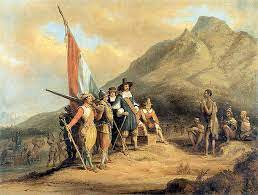
Cape Town was founded by the Dutch East India Company or the Vereenigde Oost-Indische Compagnie (VOC) in 1652 as a refreshment outpost. The outpost was intended to supply VOC ships on their way to Asia with fresh fruits, vegetables, meat and to enable sailors wearied by the sea to recuperate. What influenced the location of the town in the Table Bay area was the availability of fresh water which was difficult to find in other areas.
The town developed largely as a result of developments that took place both in Europe prior to the establishment of the refreshment station at the Cape. Muslim traders dominated the spice trade in the Indian Ocean in the medieval period. They shipped spices from India to the Persian Gulf, the Red Sea and eventually on to overland trade routes that led to Europe. European traders bought gold from Africa and exchanged it for spices and silk in Asia.
Krotoa (known as Eva to the Dutch and English settlers) was the niece of Autshumao, a Khoi leader and interpreter to the Dutch (he was known as Harry/Herry first by the English and then by the Dutch).
A young Krotoa, of about 10 or 11 years old, was taken in by Jan van Riebeeck during the first few days of Dutch settlement in the Cape. She worked as a servant to the Commander’s wife, Maria van Riebeek (nee de la Quellerie), and is first mentioned in van Riebeeck’s diary in January 1654 as ‘a girl who had lived with us’. She mastered Dutch and Portuguese and responded eagerly to Christian instruction given her by Maria.
As her command of the Dutch language and her familiarity with Dutch ways grew, so did her usefulness as an interpreter. Krotoa established herself as a staunch friend of the Dutch, negotiating a co-operative relationship between the fort and the followers of her rich relative Oedasoa. She was later instrumental in working out terms for ending the First Dutch-Khoi-khoi War.
In the 1650s Eva was the only figure possessing an intimate knowledge of both Khoikhoi and Dutch culture; as she passed back and forth between one society and the other, she exchanged her Dutch clothing for Khoikhoi skins, and vice versa.
In 1662 Krotoa became the first indigenous Southern African to be baptised a Christian, and the Dutch settlers named her Eva.